Seminario
- https://fisica.unife.it/it/eventi/seinario
- Seminario
- 2026-10-20T16:00:00+02:00
- 2026-10-20T17:00:00+02:00
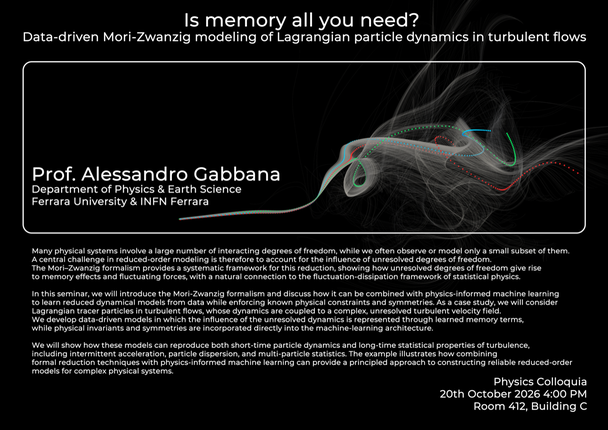
- Is memory all you need? — Data-driven Mori-Zwanzig modeling of Lagrangian particle dynamics in turbulent flows Speaker: Alessandro Gabbana Department of Physics & Earth Science Ferrara University & INFN Ferrara
Is memory all you need? — Data-driven Mori-Zwanzig modeling of Lagrangian particle dynamics in turbulent flows Speaker: Alessandro Gabbana Department of Physics & Earth Science Ferrara University & INFN Ferrara
-
Quando
il 20/10/2026 dalle 16:00 alle 17:00
 Aggiungi l'evento al calendario
 Aggiungi l'evento a Google Calendar
Per il ciclo "Colloqui di dipartimento" il giorno 20 ottobre alle ore 16 presso la stanza C412, Alessandro Gabbana Department of Physics & Earth Science Ferrara University & INFN Ferrara terrà un seminario dal titolo
Is memory all you need? — Data-driven Mori-Zwanzig modeling of Lagrangian particle dynamics in turbulent flows
Abstract
Many physical systems involve a large number of interacting degrees of freedom, while we often observe or model only a small subset of them.
A central challenge in reduced-order modeling is therefore to account for the influence of unresolved degrees of freedom.
The Mori-Zwanzig formalism provides a systematic framework for this reduction, showing how unresolved degrees of freedom give rise to memory effects and fluctuating forces, with a natural connection to the fluctuation-dissipation framework of statistical physics.
In this seminar, we will introduce the Mori-Zwanzig formalism and discuss how it can be combined with physics-informed machine learning to learn reduced dynamical models from data while enforcing known physical constraints and symmetries. As a case study, we will consider Lagrangian tracer particles in turbulent flows, whose dynamics are coupled to a complex, unresolved turbulent velocity field.
We develop data-driven models in which the influence of the unresolved dynamics is represented through learned memory terms, while physical invariants and symmetries are incorporated directly into the machine-learning architecture.
We will show how these models can reproduce both short-time particle dynamics and long-time statistical properties of turbulence, including intermittent acceleration, particle dispersion, and multi-particle statistics. The example illustrates how combining formal reduction techniques with physics-informed machine learning can provide a principled approach to constructing reliable reduced-order models for complex physical systems.